
Black Horse Racing Header

“If you’re not moving, you’re standing  still.”


Steve Trafton

Trek from Washington DC to Pittsburgh

Trek from Washington DC to Pittsburgh
Via the C and O Canal

and the Allegany Highlands Trail


Total length 320 miles
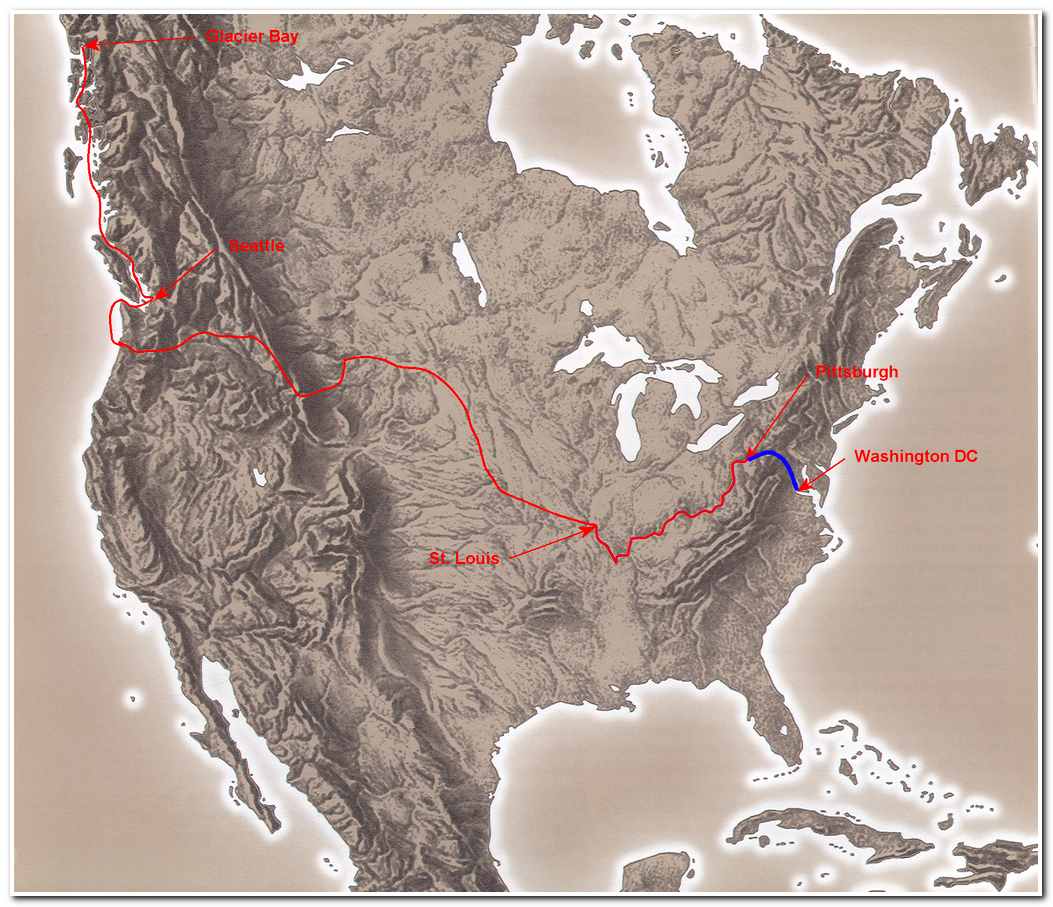
image001

Segment #1: The C and O Canal;

Washington DC to Cumberland, Maryland:

187 miles


This traces the trek from Washington DC to Pittsburgh, a total distance of 320 miles. My adventure started in Washington DC, on the shores of the Potomac River, at the Army War College near Anacostia, home of the offices of the Joint Chiefs of Staff. The route from the War College to the beginning of the famous C and O Canal and loosely followed the route of the long forgotten Washington City Canal from the Potomac north to the Capital building and then west across the Capital Mall then up Pennsylvania Avenue past the White House. From the White House I hiked to the C and O Canal trail-head in Georgetown. The Washington City Canal was constructed in 1810 during Madison’s presidency and ran from the Potomac River to the Washington Branch of the C and O Canal, joining at what is now the corner of 17th and Constitution Avenue. This canal was used until about 1855 when it was abandoned and eventually largely replaced with Constitution Avenue, which runs along the north side of the Mall. The old lock house at the corner of 17th and Constitution still stands and is now a public toilet.
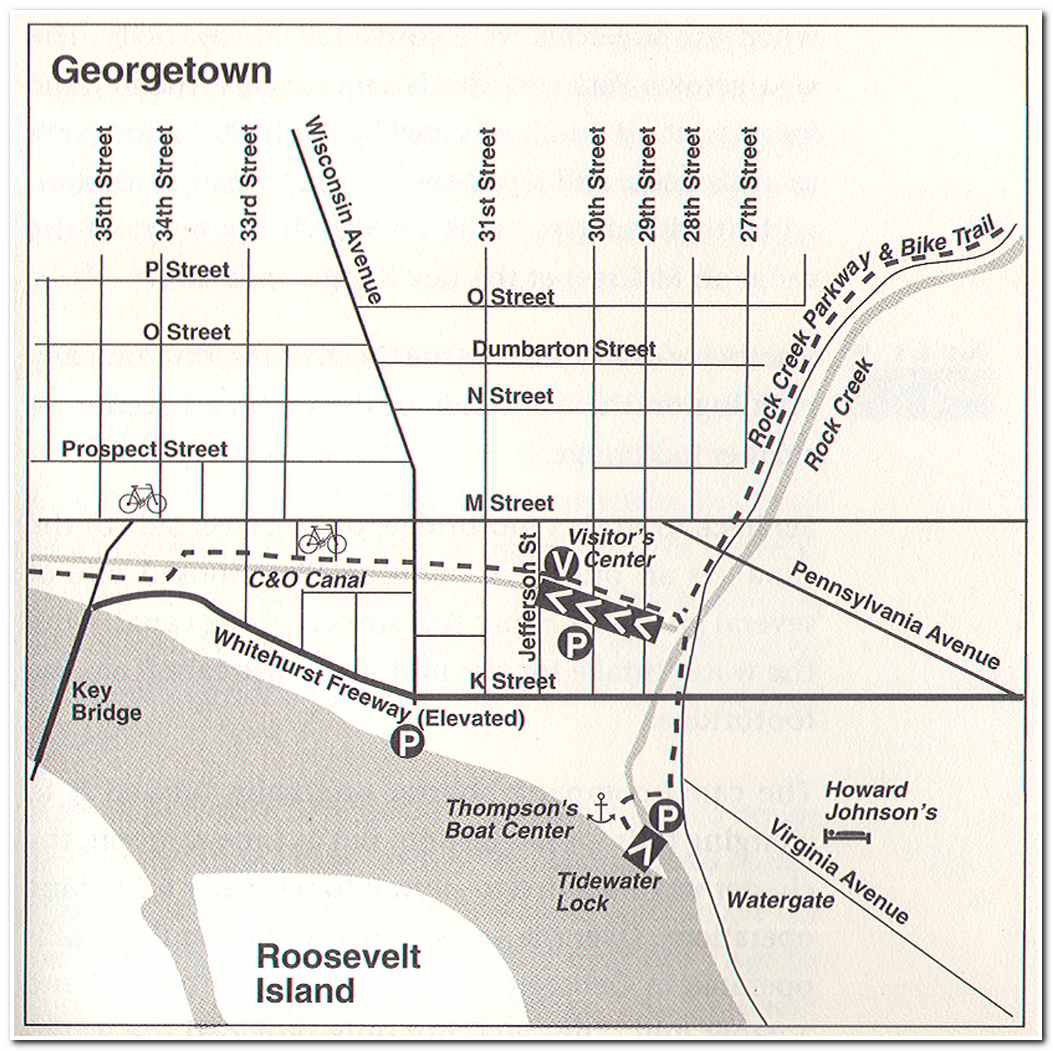
image003

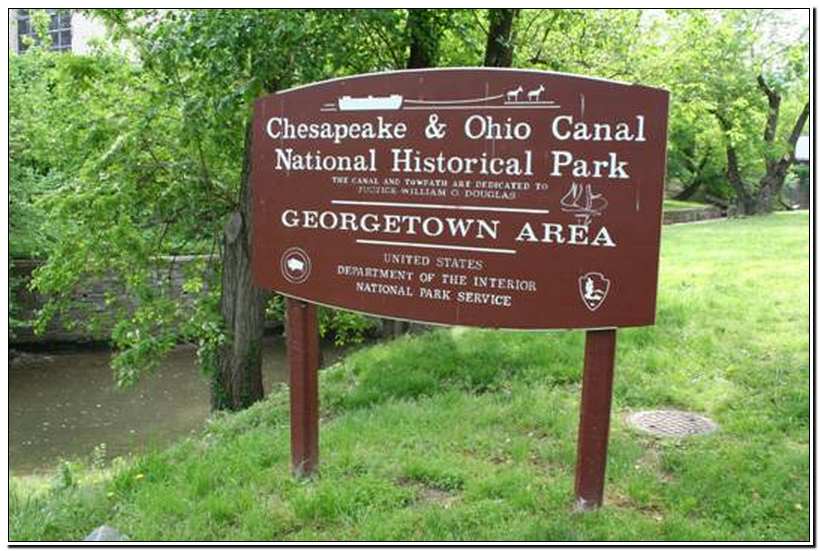
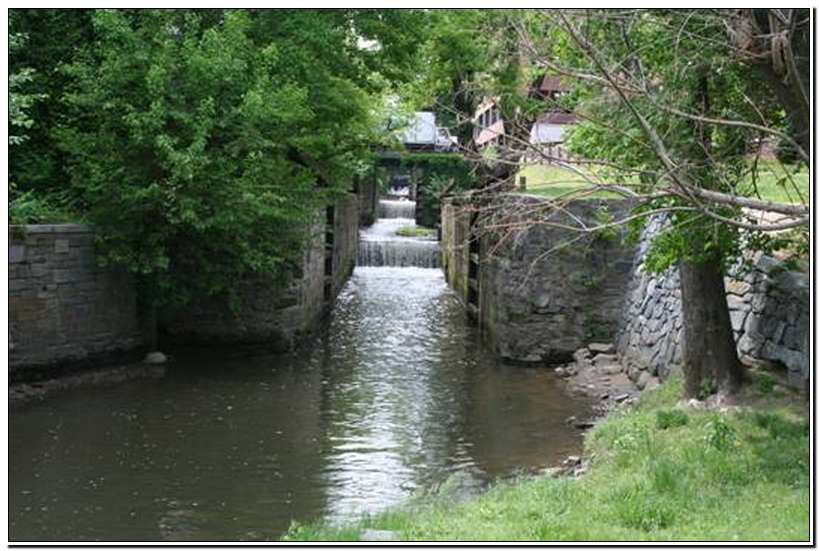
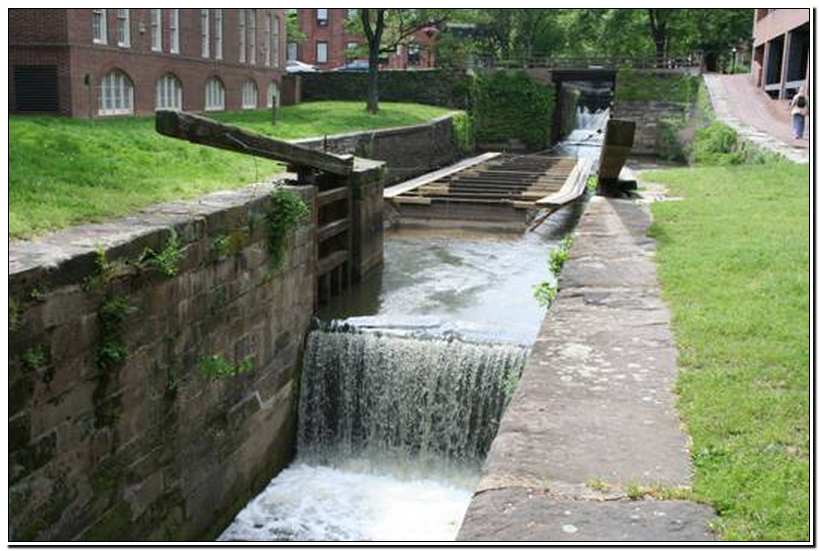
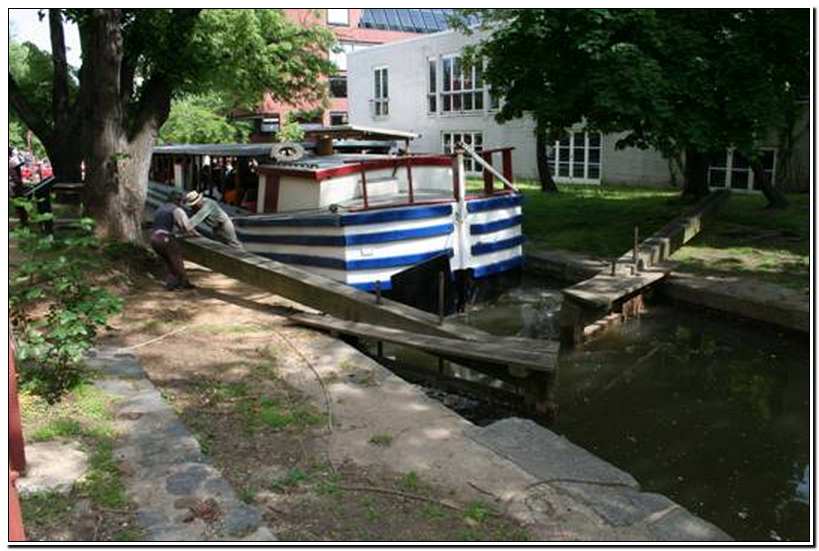
The trailhead of the C and O Canal (milepost 0) is near the Four Seasons Hotel in Georgetown and offers a pleasant urban walk through Georgetown and then generally north out of Washington DC along the Potomac. I soon left the hustle of the big city behind and the trail, which is actually the towpath along side the canal, continues through a park like setting past a number of old canal locks. There are 74 lift locks between Washington and the canal terminus at Cumberland, Maryland with lifts of between 6 and 10 feet (8.2 foot average) for a total lift of 610 feet in 184.5 miles. The locks are 90 feet long, 15 feet wide (the canal boats were 14 ½ feet wide) and 16 feet deep. Horses and mules were used as tow animals and for the most part the towpath follows the river side of the canal.

After about 5 miles I passed Locks #5 and 6 at Little Falls I crossed the boundary between Washington DC and the state of Maryland. Lock #6 named “Magazine Lock” after the US Powder Magazine 0.3 miles upstream where President Adams inaugurated C and O Canal construction on the 4th of July 1828 (the canal ceased operation in 1924). Soon I began to settle into my 3.5 mile per hour hiking pace.
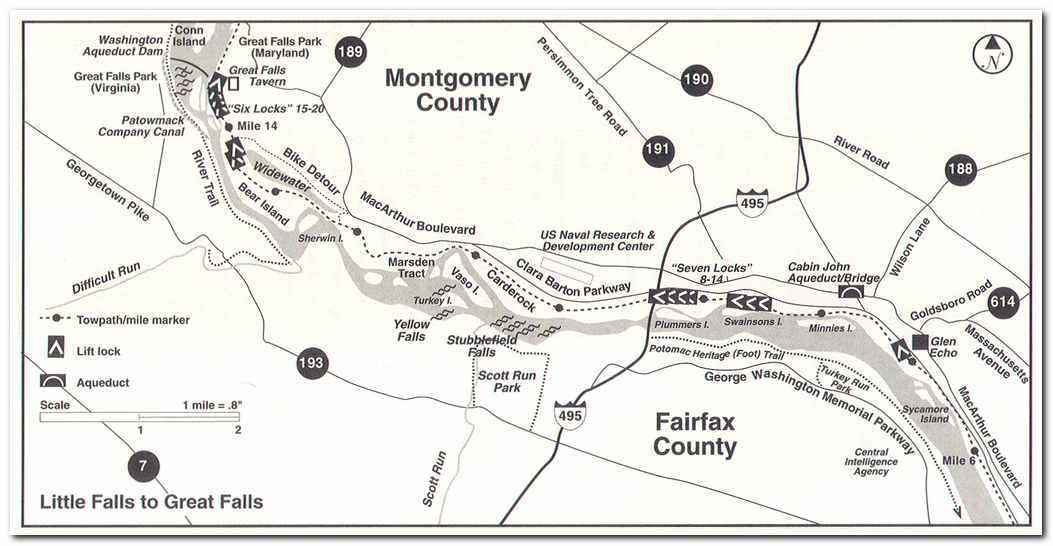
image005

At milepost 8.4 I passed by Lock #8, the first of the ‘Seven Locks’ that are passed within a one mile stretch and raised the barge traffic about 50 feet in total. About three hours from the start I passed under the Capital Beltway bridges (milepost 9.3) and past Lock #14. At milepost 9.6 I passed the Naval Ship Research and Development Center. This extensive installation includes a 2775 foot deep water model basin where the Navy’s ship and aircraft experts learn how ships and their machinery and aircraft are likely to behave in their real life environment. At mile 9.9 there is a sign designating the start of the “Billy Goat Trail”. This 1.7 mile loop trail along the river that meanders through forest and rocky outcroppings and provided a nice change of pace to the tamer and more predictable towpath trail along the canal. At milepost 10.9 I rejoined the towpath and continued on to Great Falls Tavern (milepost 14.4). This well known tourist site and was once a lock house for Lock #20 and a hotel for visitors to the Great Falls of the Potomac. From Great Falls it was another two hours of gentle hiking to Lock #23 (milepost 22) near the town of Seneca, the terminus for my first day on the canal.

image019

From Lock #23 the trail continues to follow the Potomac past the Seneca Creek Aqueduct and Lock #24 (milepost 22.7). Here the towpath turns the distinctive red shade of the Seneca sandstone that was used as roadbed material.

image021

At milepost 27.2 I started through the McKee-Besher Wildlife Management Area a 300 acre preserve which many local birdwatchers enjoy throughout the year. At mile 30.6 I came to Goose Creek River Locks. These locks admitted boats from the Potomac River and from Goose Creek on the opposite Virginia shore. These “river locks.” One opposite the Shenandoah River at Harpers Ferry and one opposite Shepherdstown and the one at Goose Creek, were demanded by the Virginia Legislature of 1833 to provide a market for Virginia products in return for the purchase C and O Canal stock. At milepost 30.9 I walked past Edwards Ferry. In October 1861, Union troops crossed the river here in a supporting action to the crossing upstream at Whites Ferry (milepost 35.5) during the battle of Balls Bluff. After the battle of Chancellorsville, the Union army built a pontoon bridge across the river here, anticipating that they might have to cross the Potomac from Leesburg to follow the Confederate army north. The crossing did come to pass on June 25 and 26, 1863 after it was learned that Lee was moving up the Shenandoah Valley to invade Maryland and Pennsylvania. Two weeks later the armies would meet at Gettysburg.

image023

After passing Edwards Ferry it was another hour long hike to reach the Whites Ferry (milepost 35.5). Whites Ferry is the only active ferry still remaining along the Potomac. The ferry has been in operation since 1817 when it was originally known as “Conrad’s Ferry”. In 1871 Elijah White, a former confederate officer bought the ferry and named it the General Jubal Early in honor of his former commander. I took the ferry across and walked into Leesburg where I explored the town and then spent the night after a short day.

The General Jubal Early makes a crossing at Whites Ferry

The General Jubal Early makes a crossing at Whites Ferry


Day three on the canal started at shortly after ten in the morning. This time I walked the bridge back across the Potomac and began my hike along the towpath. At milepost 38.2 I passed by the site of the “Marble Quarry.” The quarry predated the C and O Canal and was said to run along the river for more than a mile. The stone that was quarried here was known as “Potomac marble” but it was quite different from the veined marble that was quarried in Tennessee and Georgia. Potomac marble was a limestone breccia composed of sharp angular pebbles cemented in a limestone matrix. After the British burned Washington in 1814 architect Benjumin Latrobe traveled up the Potomac to find marble for the two story columns in the House of Representatives chamber (now statuary Hall and the Senate chamber). The C and O Canal hadn’t been built yet, so the blocks of stone had to be boated down the river to Washington then transported to the site of the new capital building.

A short distance upriver from the quarry is Whites ford (milepost 39). This is the site where J.E.B. Stuart escaped back across the Potomac to Virginia in October 1862 after his ride around the Union army after the battle of Antietam.

image027

At milepost 41.5 is Lock #27. Confederate troops under General D.H. Hill, frustrated in their efforts to blow up the Monocacy Aqueduct at the outset of the Antietam campaign, turned their attention to disabling this lock on September 4th and 5th 1862. After the battle of Antietam, the canal company board dismissed the lockkeeper for allegedly collaborating with the Confederates. Several of his neighbors petitioned the board of directors on his behalf but to no avail.

At milepost 42.2 I crossed the Monocacy Aqueduct, a 560 foot long elevated portion of the Canal is divided into seven 54 foot arches and carries the canal over the Monocacy River. It was here that Hill tried to disable the canal. To expedite his crossing into Maryland Hill’s men leveled the canal banks, drained the canal and laid a corduroy path across the canal. While they were unable the destroy the aqueduct for lack of explosives they did wreck a portion of Lock #27. On Lee’s orders, a second attempt to demolish the aqueduct was made by General John Walker on the night of September 9th, but was unsuccessful. As Union troops approached, Walkers men had to move on, crossing back over the Potomac on their way to Loudoun Heights to complete the encirclement of Harpers Ferry.

Milepost 44.6, Noland’s Ferry. Here many of the 500 or so British and German prisoners from Saratoga (1778) crossed at the ferry on their way to prison camps in Virginia. It was a difficult winter crossing, with the scows frequently trapped by ice floes and drifting as far as a mile below the ferry crossing. This route became less used as the city of Washington was built further downstream. It was an occasional crossing point furing the Civil War for small outfits such as Mosby’s famous Partisan Rangers, who were based across the river in Loudoun County.

image029

Pages: 1 2 3 4 5 6 Next »